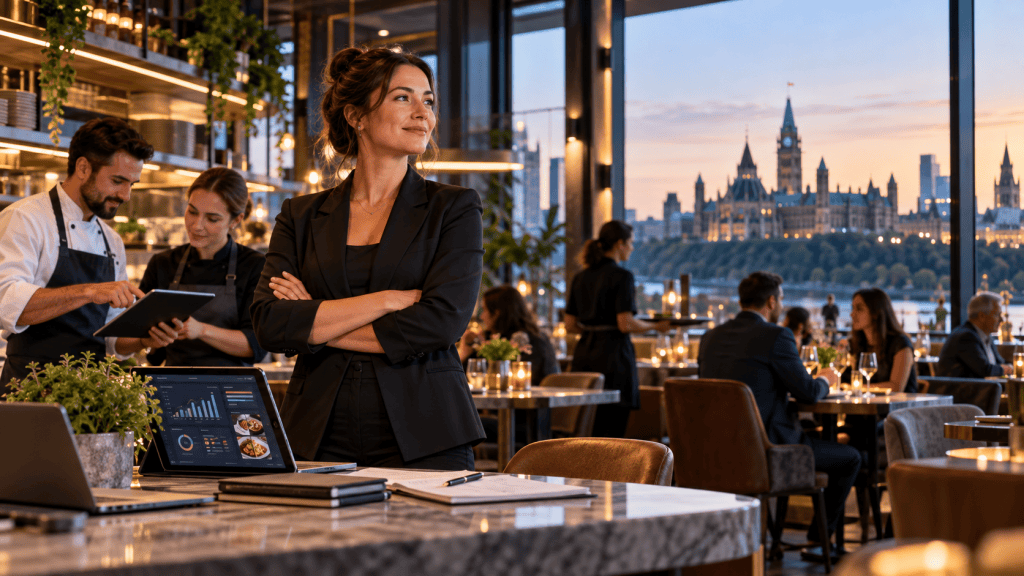
As 2027 approaches, the restaurant industry continues to transform with emerging trends and technologies. Even though no major shifts in diners’ preferences are expected in the coming year, the business landscape in Ottawa is changing.
With increasing competition, tighter margins, and more selective consumers, restaurant operators need to rethink how they position themselves in the market.
Here’s a quick guide on how to run a successful restaurant in Ottawa in 2027.
1. Adjust Your Positioning
Market needs are shifting, and your current business model or market positioning might no longer be working in your favour.
Ottawa’s restaurant scene is becoming more crowded and diverse every day. With an abundance of choices, convincing diners to choose your restaurant is becoming harder than before.
The growing number of restaurants, combined with shrinking dining-out budgets, is making residents more sensitive to the value they receive. But offering better value doesn’t necessarily mean giving more for less.
You may also like;
Ottawa restaurant operators are already under significant margin pressure, and many mistakenly believe that entering a price war will save their businesses.
To run a successful restaurant in Ottawa in 2027, it’s time to move beyond this misconception and start by redefining your brand, revisiting your positioning, and refining your core values.
An easy way to get started is by answering one fundamental question:
“What problem is my restaurant solving in today’s market, and why does it matter?”
Take your time finding the answer. Talk to your leadership team, employees, and guests, and conduct some market research.
Finding the right answer might take several days, and that’s perfectly fine. A clear understanding of your place in the market is worth the effort.
2. Are You Targeting the Right Segment?
You may have noticed a drop in your guest count over the past year. Whether slight or dramatic, this shift in covers could be telling you something important: Something needs to change.
We’re already experiencing margin pressure, average checks are declining for some operators, and guest counts are shrinking. So how is your restaurant supposed to survive, let alone grow?
Remember the first piece of advice? Now it’s time for the second part of the same strategy.
Once you’ve adjusted your positioning and identified the specific problems your restaurant solves, the next step is to target the right customer segments: the people who actually experience those problems and value the solutions you offer.
Not every diner is your ideal guest, and trying to appeal to everyone often leads to appealing strongly to no one.
By focusing on the right segments, you can shift the conversation away from price and toward value. You’re also more likely to attract guests with higher lifetime value (LTV), as they have stronger reasons to return.
The goal isn’t necessarily to bring in more people at any cost. It’s to attract the right people, give them a compelling reason to choose you, and build relationships that last.
Remember: If people can’t identify what makes your restaurant different, they’ll judge you by your price.
And that’s exactly what we want to avoid when building a successful restaurant in 2027.
3. Communication Is Your Life Jacket
I’ve personally experienced poor communication in many restaurants, and I believe it’s a chronic problem across the industry.
When teams and operators are overwhelmed by day-to-day stress and constantly putting out fires, clear communication often becomes an afterthought.
Unfortunately, its importance becomes even more obvious during challenging times.
New restaurants continue to open across Ottawa, competition is intensifying, and many people are dining out less frequently. That leaves restaurant operators with less room for operational mistakes and communication breakdowns, both internally and externally.
After repositioning your restaurant around relevant market needs and identifying the right customer segments, your next task is to communicate your value in a way that makes sense to your audience and stays in their minds.
And when I say communication, I don’t just mean verbal, written, or digital communication.
The lighting in your restaurant, the language your servers use, your plating, the smell of your dining room, and even the smallest details of the guest experience all communicate something about who you are.
Together, these elements shape how people perceive your brand and naturally help differentiate your restaurant in the market.
Your restaurant is communicating with guests all the time, even when nobody is speaking.
Take a closer look at these details through the lens of your newly defined positioning. Identify what supports your vision, what contradicts it, and what needs to change.
Then, turn your attention to internal communication.
Clearly explain your new direction, decisions, and expectations to your team. Make sure they understand not only what’s changing but also why those changes matter.
Provide training where necessary, encourage feedback, and create consistency between what your brand promises and what your team delivers.
After all, your employees are the number one ambassadors of your brand.
If your team doesn’t understand what makes your restaurant special, how can you expect your guests to?
Final Thoughts: Success in 2027 Starts With Clarity
Running a successful restaurant in Ottawa in 2027 won’t necessarily be about having the lowest prices, the biggest menu, or the most aggressive marketing campaigns.
It will be about knowing exactly where your restaurant fits in an increasingly competitive market, understanding who you’re serving, and delivering an experience that consistently reinforces your value.
The three ideas we’ve discussed are closely connected:
- Positioning defines why your restaurant deserves a place in the market.
- Targeting ensures you’re reaching the people who value what you offer.
- Communication makes that value visible, memorable, and consistent throughout the guest experience.
None of these strategies works particularly well in isolation.
Strong positioning means little if you’re targeting the wrong audience. Reaching the right audience won’t help much if your message is unclear. And even the best marketing can’t compensate for an in-house experience that contradicts your brand promise.
As you prepare for 2027, take a critical look at your restaurant from the perspective of your guests, your employees, and the market around you.
Ask difficult questions, challenge outdated assumptions, and be willing to make adjustments.
Because in a market full of choices, the restaurants that succeed won’t necessarily be the ones that offer the most. They’ll be the ones that give the right people the clearest reasons to choose them.


Leave a Reply